What You Actually Learn About Exam Patterns From RBI Grade B Previous Year Papers?
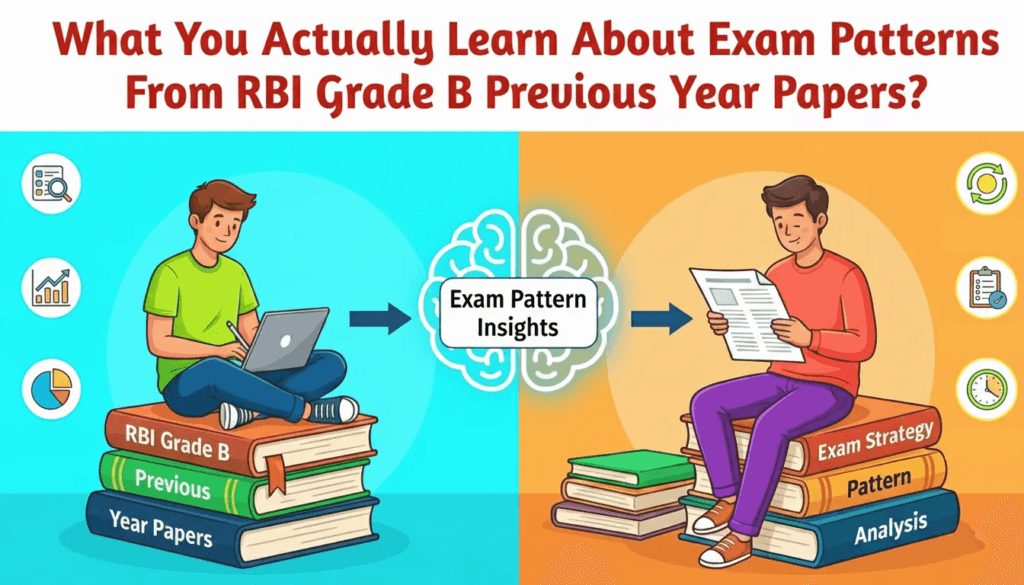
Many students download the RBI Grade B Previous Year Question Paper to do only one thing.
Practice Questions.
However; that alone is not sufficient.
Reading past year papers for the RBI Grade B examination will show you a lot more than just the correct answer. It will also provide insight into what RBI believes about thinking for this exam, the evolution of the examination format and what type of preparation will help you achieve success in this exam.
Below, we discuss what you can really learn from studying RBI Grade B Previous Year Papers in detail.
RBI Grade B Previous Year Papers Show the Real Meaning of the Syllabus
On the surface of things, the RBI Grade B Syllabus appears to be a broad syllabus.
At the outset, it will look very intimidating.
Past year papers clearly reduce this.
They demonstrate that:
- There is no similar amount of emphasis on all the subjects.
- Certain topics repeatedly come up every year.
For example:
- When it comes to ESI, knowing how to analyze topics such as inflation, growth, and government policy is much more important than memorizing definitions.
- In finance, having conceptual clarity is far more beneficial than performing numerous calculations.
- In management, basic theories are adequate if you know how to use them.
Past year papers enable you to determine what is important and what is secondary within the scope of the RBI Grade B syllabus.
RBI Grade B Does Not Ask Straightforward Questions
A clear trend has been shown by previous years’ exams.
RBI doesn’t ask students direct questions.
Even static questions are asked around:
- Real economic events
- Recent policy developments
- Banking/Financial Events
Phase 2 is very evident of this trend.
You learn from the RBI Grade B Previous Year Question Paper that RBI doesn’t test you on memorizing, but rather on your ability to understand and interpret.
What Phase 1 Previous Year Papers Reveal
Phase 1 is usually underestimated.
It is considered by many aspirants as merely a qualifying phase.
Previous year papers indicate why this method is risky.
They reveal that:
- General Awareness is highly focused on Economy and Banking
- Random static GK has limited importance
- Current affairs are not headline-based, but rather issue-based
Questions often relate:
- A policy decision with inflation
- A banking reform with financial stability
So, Phase 1 is not just about speed. It is about knowing what to focus on.
Phase 2 Papers Reveal the Real Exam Pattern
Phase 2 is where RBI actually tests the candidates.
This is very evident from the previous year papers.
Economic and Social Issues (ESI)
ESI questions are seldom direct.
They test:
- Conceptual Clarity
- Ability to link theory with current issues
- Knowledge of government and global reports
You learn that:
- Static economics is not enough
- Current issues must be understood conceptually
- Examples and data strengthen answers
Finance and Management (FM)
From the previous year papers, it is clear that this trend is stable.
In Finance:
- Banking and financial systems dominate
- Risk management and Basel norms are frequently mentioned
- Understanding is more important than formulas
In Management:
- Basic theories are enough
- Scenario-based questions are common
- Real workplace situations are preferred
This tells you something important.
RBI requires officers with knowledge of systems, not textbook knowledge.
English Papers Reveal How RBI Thinks About Communication
English is usually neglected in the process.
The previous year papers will reveal why this is a mistake.
The English descriptive papers of RBI assess:
- Clarity of thought
- Logical structure
- Ability to explain complex issues simply
They do not reward:
- Fancy Vocabulary
- Flowery language
- Memorised templates
The past papers reveal that RBI values clear thinking over stylish writing.
The Exam Pattern Is Stable, But the Focus Keeps Shifting
Another thing that can be learned from the previous year papers is subtle but very important.
The pattern of the exam remains largely the same.
But:
- Focus areas keep changing
- Level of questioning keeps changing
- Relevance to current times keeps shifting
This implies that:
- Guessing questions is not a good idea
- Overlooking the basics can be dangerous
- Preparation needs to be multi-layered and consistent
The previous year papers illustrate how RBI keeps changing questions without altering the syllabus.
Previous Year Papers Prevent Over-Preparation
Aspirants study too much.
They use:
- Too many books
- Too many notes
- Too many sources
Previous year papers quietly tell you:
- What RBI repeatedly asks
- What RBI rarely touches
- Where additional effort does not give returns
They help you study with control.
How to Use RBI Grade B Previous Year Question Papers Correctly
Solving papers is not enough.
The right approach is to:
- Analyzing the reasons behind the formulation of the question itself
- Map it to the RBI Grade B Syllabus
- Determine whether it is static or current-based question
- Notice the way options are presented
- Focus on the thinking pattern
This helps build exam intuition over time.
Final Thought
The RBI Grade B Previous Year Question Paper is not only meant for practice.
It is a guide.
It shows you:
- How RBI interprets its own syllabus
- What depth of knowledge is expected
- What kind of thinking is rewarded
If you actually grasp previous year papers, then your preparation will be specific.
“RBI Grade B is not about studying more.” It is about studying with direction.